stillmantle.com
The Museum Archive | Turkish Epidote Boxwork Specimen
The Museum Archive | Turkish Epidote Boxwork Specimen
Couldn't load pickup availability
A Geological Memory Preserved in Stone.
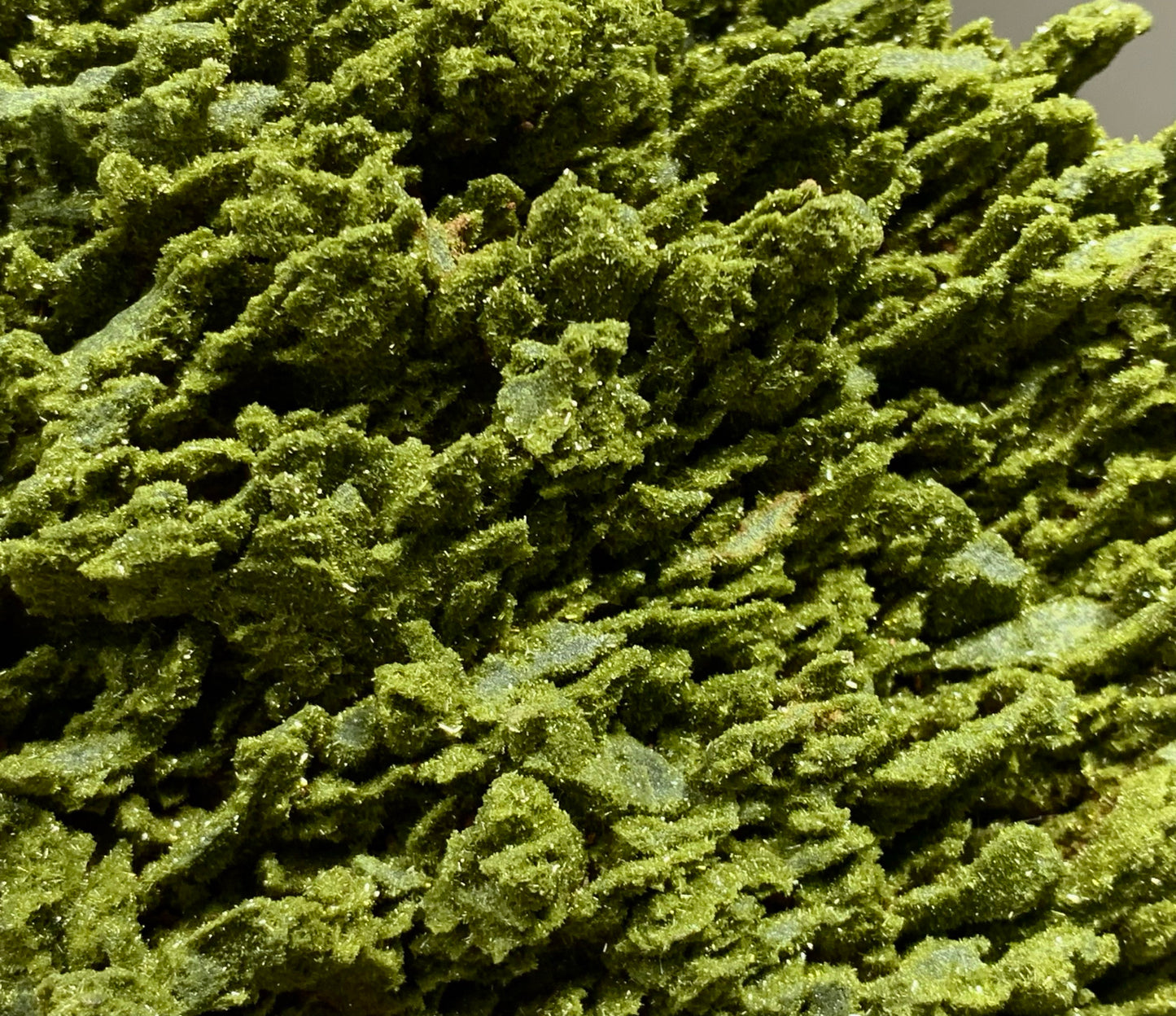
A rare Turkish Epidote epimorph displaying an intricate hollow boxwork structure formed through an extraordinary geological process. Rather than developing as conventional crystal points, this specimen preserves the outer framework of an earlier mineral that has long since disappeared.
Millions of years ago, velvety epidote micro-crystals enveloped a precursor mineral—likely anhydrite or barite. Over time, the original mineral dissolved away, leaving behind only this complex skeletal architecture. The result is a remarkable natural cast: a labyrinth of interconnected chambers, voids, and delicate mineral walls preserved in three dimensions.
Its pistachio-green coloration and dense microcrystalline druzy create an unexpectedly organic appearance, evoking ancient moss, weathered landscapes, or fragments of petrified vegetation. The contrast between its architectural voids and soft, velvety texture gives the specimen a distinctive presence that feels both geological and botanical.
Aesthetic Color & Texture Distinction
Curation Note: Characterized by its signature pistachio-green hue and intricate boxwork formation, this uncommon specimen introduces a strong biophilic quality to contemporary interiors. The interplay between its hollow architectural structure and moss-like surface texture creates a naturally sculptural focal point suited to organic modern, contemporary, and inspired spaces.
Material & Specifications
• Mineral: 100% Natural Turkish Epidote Epimorph
• Origin: Turkey
• Dimensions: Approx. 131 × 128 × 94 mm (5.1 × 5.0 × 3.7 in)
• Structure: Hollow boxwork architecture formed through natural epimorphic replacement
• Surface Texture: Velvety microcrystalline druzy
• Treatment: Completely raw, unpolished, and free from enhancement
Transparency Note
You will receive the exact one-of-a-kind specimen shown. The asymmetrical cavities, natural mineral overgrowths, inclusions, and structural irregularities visible throughout the piece are authentic geological features rather than imperfections. This specimen remains entirely unpolished and unaltered, preserving the full character of its natural formation.
• Display Note: Any bases, travertine slabs, or staging props shown in photographs are for digital curatorial context only and are not included.
Share